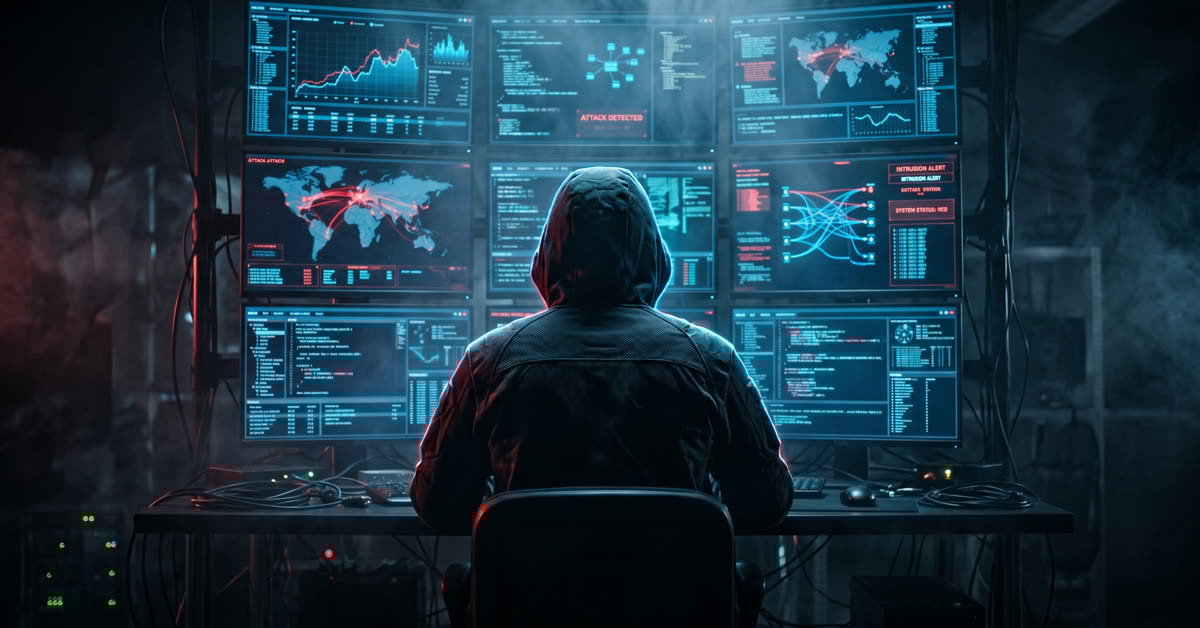

For a decade, the advice on business email compromise was simple: read carefully. Watch for the typos, the odd grammar, the sender address that's one character off. That advice is now obsolete. Generative AI writes flawless, on-brand emails in seconds, and it can clone a human voice from a few seconds of audio pulled off a podcast, an earnings call, or a webinar. The tells are gone.
The result is a new class of attack that doesn't rely on tricking a distracted employee with a sloppy message. It relies on impersonating your CEO so convincingly — in writing, on the phone, and even on video — that a reasonable, competent person wires the money and never doubts it happened.
This is not a future threat. It's landing in Ohio inboxes and on Ohio phone lines right now, and small and midsize businesses are the softest targets in the country.
What business email compromise actually is
BEC is fraud, not malware. There's no infected attachment to catch and no ransomware note. An attacker impersonates someone you trust — the owner, the CFO, a known vendor — and manipulates a person into moving money or changing where money goes. Because it exploits trust and process rather than software, your antivirus never fires. That's exactly why it works, and why it's so expensive.
According to the FBI's Internet Crime Complaint Center, BEC drove more than $3 billion in reported losses in 2025 alone, with an average loss north of $120,000 per incident. It remains one of the most financially destructive cybercrimes in the United States — and the overwhelming majority of that money moves out the door by wire transfer or ACH, straight through legitimate banking workflows.
How AI supercharged the old playbook
The classic BEC email hasn't disappeared — it's gotten better. Generative AI removes every quality signal defenders used to rely on. The grammar is perfect. The tone matches how your executive actually writes. The message references a real project, because attackers scrape LinkedIn, your website, and press releases first.
Then it escalates off email entirely:
- The cloned voice. An employee gets a call that sounds exactly like the CEO — same cadence, same accent — asking them to push through an urgent payment. Deepfake-enabled voice fraud has exploded, and a usable voice clone now takes only a few seconds of public audio to build.
- The fake video call. In one widely reported case, a finance worker at the engineering firm Arup joined a video conference with what appeared to be the CFO and colleagues and authorized transfers totaling roughly $25 million. Every other face and voice on the call was AI-generated.
- The invoice swap. A trusted vendor emails to say their bank details have changed. The email is real-looking, the timing fits an outstanding invoice, and your next payment routes to the attacker.
The scale is climbing fast. By some estimates, deepfake-driven fraud drained more than $1 billion from U.S. corporate accounts in 2025, roughly triple the prior year.
Why SMBs are the prime target
Attackers aren't only chasing Fortune 500 payrolls. A 40-person company is an ideal victim, because the ingredients line up: fewer people separating a request from a payment, an owner or controller who can move money quickly, and rarely a formal callback rule. The executive's voice and photos are just as public as any big-company CEO's — on the company website, a chamber-of-commerce video, a conference talk.
And the loss lands harder. A six-figure fraudulent wire is an accounting footnote for a large enterprise. For an SMB, it can be a missed payroll, a broken credit line, or an existential event. Recovery is unlikely once the funds are gone — most of this money is overseas within hours.
The defenses that actually work
Deepfakes are convincing, but the fraud still has to pass through your payment process to succeed. Harden the process and you break the attack, regardless of how real the voice sounds.
- Out-of-band verification. Any payment request, or any change to bank details, gets verified through a second, independent channel — a phone call to a known number on file, never the number or reply address in the message. If the request came by email, confirm by phone; if it came by phone, confirm through a separate known contact. This one habit defeats voice clones outright.
- Payment-change controls and dual approval. Vendor banking changes require documented verification and a second set of eyes. Wires over a set threshold need two approvers. Urgency is treated as a red flag, not a reason to skip steps — real executives expect this.
- Email authentication and advanced filtering. Properly configured SPF, DKIM, and DMARC make your domain far harder to spoof and stop lookalike mail before it lands. Layer on email security that flags impersonation patterns, newly registered lookalike domains, and inbox rules attackers set to hide their tracks.
- Continuous awareness training. Your team needs to know these attacks exist, know that a familiar voice is no longer proof of identity, and feel safe pausing a payment to verify. Periodic phishing simulations keep the reflex sharp and turn "read carefully" into "verify, always."
The mindset shift owners have to make
The old model treated verification as an insult — a sign you didn't trust the boss. That has to flip. In a world where any voice can be faked, verifying is the professional standard, and a leader who says "always confirm my payment requests through the callback process, no exceptions" is protecting the whole company. The goal isn't paranoia. It's a payment workflow that doesn't depend on any single human correctly telling a real voice from a synthetic one — because increasingly, no human can.
Where Torchsec fits
Stopping AI-driven BEC isn't one product. It's email security tuned for impersonation and BEC, layered defenses across identity and inbox, and — just as importantly — the human and procedural controls that catch what technology misses. Torchsec implements all three: hardened email authentication and anti-phishing protection, security awareness training with realistic phishing simulations, and the practical payment-verification and approval processes that turn your team into the last, reliable line of defense.
If a call from "the CEO" asking for an urgent wire would land somewhere in your business today, that's the gap to close. Torchsec builds the email security, training, and process controls that shut it down — get in touch.
Ready to talk?
If any of this sounds familiar, we'd be happy to walk your team through it. Book a no-obligation consultation or request a free risk assessment.